Interim Pres. Smith Releases Podcast Episode Addressing Political Polarization
By Hannah Castro |
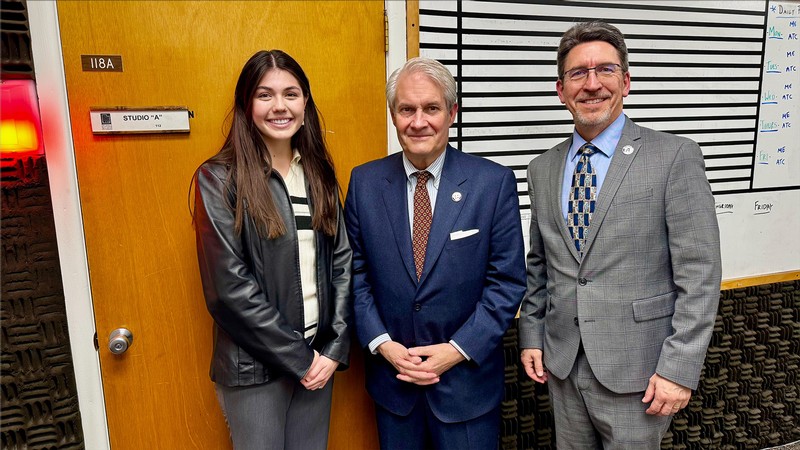
Producer Hannah Castro, Judge Thomas Griffith, and USU Interim President Alan Smith at the Utah Public Radio offices where Future Casting With Utah State is recorded.

LOGAN, Utah — Utah State University hosted its second annual Presidential Forum on Conflict and Conflict Transformation on March 25. This year’s theme, “Navigating Political Polarization: A Call to Constitutional Action,” featured retired Judge Thomas B. Griffith.
Prior to the forum, Griffith joined Interim President Alan Smith on Future Casting with Utah State, a university podcast, where they explored the topic of fostering unity in a time of national division.
Griffith brought his expertise to the discussion with his experiences as federal judge on the U.S. Court of Appeals for the D.C. Circuit, chief legal officer of the U.S. Senate, and general counsel at Brigham Young University.
Since retiring, Griffith has stayed active in legal and public service. He was appointed by President Joe Biden to the Presidential Commission on the Supreme Court and has served as a mediator in high-profile federal disputes. He currently is a lecturer on law at Harvard Law School and special counsel at Hunton Andrews Kurth.
Throughout the episode, they dissected constitutional principles, and Griffith emphasized the role of universities in teaching citizens about the Constitution and open-minded communication.
“It's colleges and universities today that must be leaders in teaching our future leaders, how things work under the Constitution, because it's a very particular approach to government that isn't a natural one. It's something that needs to be learned and practiced,” Griffith said. “I can think of no better setting to do that than the university setting, where ideas are welcome, disagreement is encouraged. These are all things the Constitution wants us to have.”
Another discussion topic was the importance of local communities in addressing polarization. Smith asked, “What steps can we take to engage with our communities, workplaces and even personal relationships to foster productive conversations about conflict?”
“This is going to be solved in Washington, D.C., it'll be solved in Logan, and it’s going to be solved in my hometown of Round Hill. Also to recognize that the person who disagrees with you is a fellow citizen, is a person that deserves dignity, because the Declaration of Independence tells us to treat them that way,” Griffith said. “Also, get involved in what's going on in your community, in the school board, there are lots of groups out there that work hard at overcoming this toxic polarization.”
For more information, listen to Future Casting With Utah State on UPR.org.
WRITER
Hannah Castro
Marketing and Communications Media Specialist
College of Arts & Sciences
hannah.castro@usu.edu
CONTACT
Amanda DeRito
Associate VP of Strategic Communications
University Marketing and Communications
435-797-2759
Amanda.derito@usu.edu
SHARE
Comments and questions regarding this article may be directed to the contact person listed on this page.