Maternal Investment: USU Ecology Doctoral Candidate Explores Immune Responses in Snakes
Daniel Emanuel is among more than 60 Aggie scholars presenting research at the 2026 Ecological Society of America annual meeting July 26-31 in Salt Lake City. The Department of Biology student studies antibody function in the Children's python species.
By Mary-Ann Muffoletto |
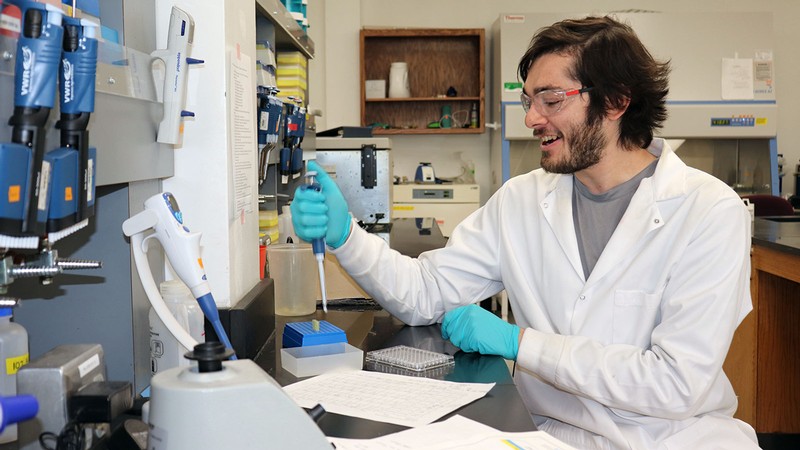
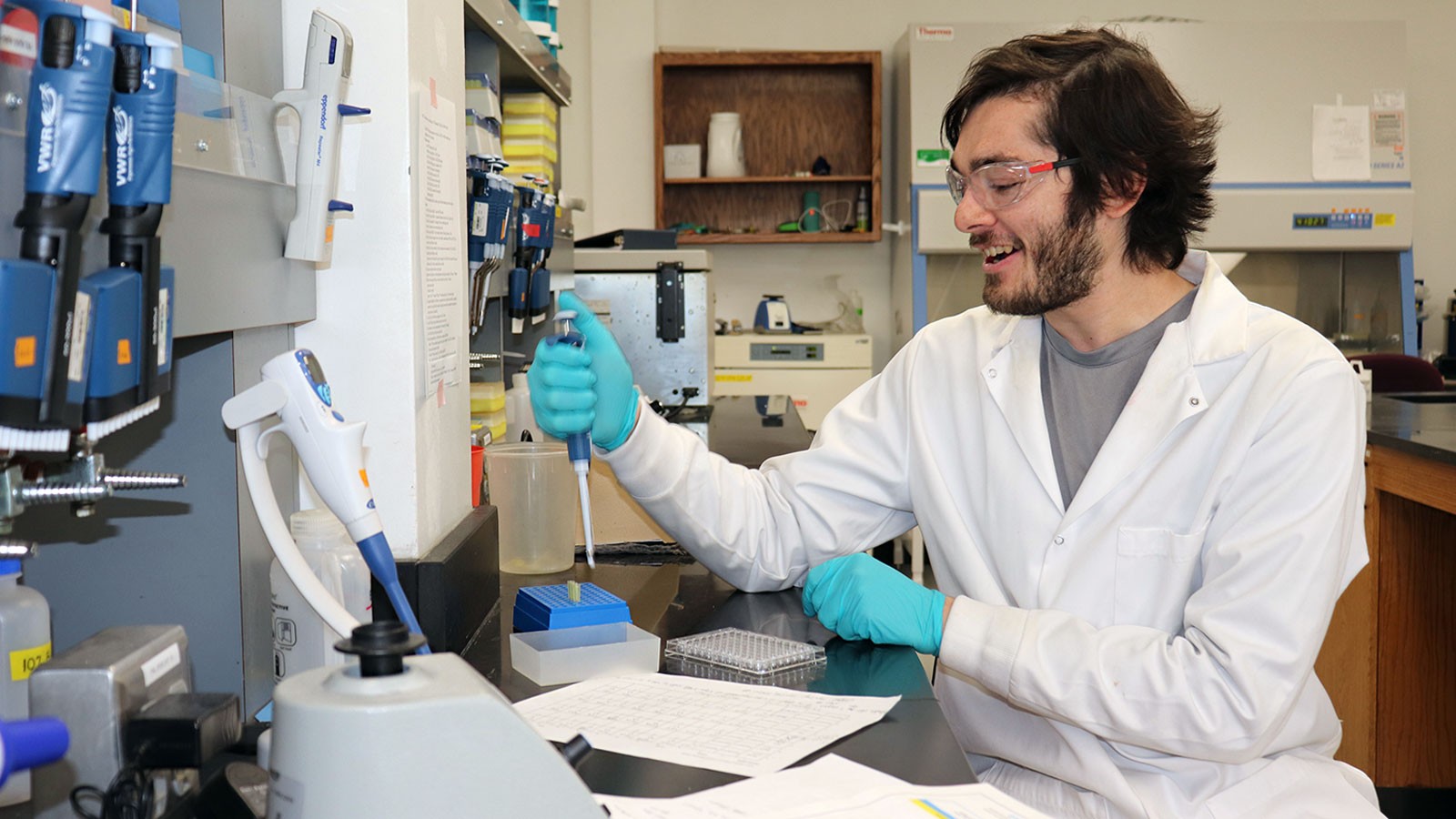
USU ecology doctoral candidate Daniel Emanuel studies the immune systems of snakes in Professor Susannah French's lab in the Department of Biology. Emanuel, elected president of the Biology Graduate Students Association for the 2026-27 academic year, is among some 60 Aggie researchers presenting at the Ecological Society of America Annual Meeting July 26-31 in Salt Lake City. (Photo credit: USU/M. Muffoletto)
Even if you’re not a fan of snakes, you may be even less a fan of a world without snakes.
“Snakes are critical for healthy ecosystems and serve as both predator and prey,” says Utah State University ecologist Daniel Emanuel. “They’re a food source for birds and mammals, and snakes eat rodents. They provide effective pest control around our homes. Some pharmaceuticals have also originated from snakes and other reptiles, including high-demand GLP-1 medications used to treat diabetes and obesity, which are derived from a venomous lizard, the Gila monster.”
Emanuel, a doctoral candidate in the Department of Biology and the USU Ecology Center, is exploring the immune responses of reptiles and, in particular, of a nonvenomous snake species called Children’s pythons. He’s among more than 60 Aggie scholars presenting research at the 2026 Ecological Society of America Annual Meeting July 26-31 in Salt Lake City.
Emanuel will present his talk, “Humoral Immune Response Differs Between Novel and Familiar Antigens in Pythons,” 1:30-3 p.m. July 29 in Salt Palace Meeting Room 255A.
“I’m interested in how these snakes produce antibodies against varied pathogens,” he says. “In particular, I’m looking at how those antibodies are passed from parent to offspring — so how mom is investing antibodies that she has in circulation into her egg yolk, which eventually makes it into her hatchlings.”
Maternal investment and antibody transfer to offspring are better known in mammals and birds, Emanuel says, but little is known about this process in reptiles. His research builds on previous work explored in the lab of his faculty mentor Susannah French, professor in the Department of Biology and associate vice provost in USU’s School of Graduate Studies.
“In reproductive physiology, the burden is mostly on the female, although males also undergo behavioral changes during propagative periods,” Emanuel says. “But females do the heavy lifting. While growing their follicles and developing offspring, females undergo big changes in their immune systems, behavior and physical wellbeing until they lay their eggs.”
Expectant Children’s python females, he says, stop eating while growing their eggs.
“They can go seven to eight months without eating,” Emanuel says. “Reproduction changes everything about their physiology.”
His work builds upon existing studies exploring dehydration and nutrition in reproductive females and how those affect offspring, including their ability to fight infection.
“Specifically, in terms of immunity, I’m interested in seeing how antibodies transferred from mom to offspring are functioning in the hatchlings, how long those antibodies last and how the offspring’s fledgling immune system develops going forward,” Emanuel says. “Having this understanding is important to basic research about snakes but also of understanding of emerging diseases.”
French describes Emanuel, who received honorable mention from the National Science Foundation Graduate Research Fellowship competition, as “an exceptionally driven and passionate graduate student, whose curiosity and dedication make him an invaluable member of the lab.”
“Daniel’s research is both innovative and impactful,” she says. “He has developed novel assays to measure snake antibodies, providing new tools that advance our understanding of snake immunology.”
Emanuel, who is a recipient of the Matt Del Grosso Endowed Graduate Research Award, the Joseph E. Greaves Endowed Biology Graduate Scholarship and the Dr. Dane Tang Hansen Endowed Graduate Research Fund Scholarship from the Department of Biology, along with two Ecology Center Graduate Research Awards, looks forward to his presentation, which will be his first time at an ESA meeting.
“I’ve presented at other professional meetings, but I’m excited to participate in the ESA community,” he says. “Presenting research helped me with critical feedback and ideas. It also helped me develop better communications skills. Another benefit was meeting researchers whose papers I’d read and getting to know people who might become future collaborators.”
French says Emanuel, who was elected president of the Biology Graduate Students Association (BGSA) for the coming academic year, is deeply engaged in the department and regularly presents his research at public outreach events, including Science Unwrapped.
“I love bringing the snakes to Science Unwrapped and seeing the different reactions,” Emanuel says. “It’s exciting to be with people as they touch a snake for the first time and realize what cool animals they are.”
He praises BGSA, as well as the USU Ecology Center, for bringing grad students together for learning, networking and fellowship during seminars and social events.
“Graduate school is intense with research, teaching responsibilities and academic demands,” Emanuel says. “The challenge of getting a research project off the ground is momentous. During this process, students are also dealing with the challenges of supporting themselves financially. Having encouragement from faculty, staff and fellow students is crucial.”
He says he’s very grateful to the USU Ecology Center for providing travel funds that will enable him to participate in the ESA meeting.
“I wouldn’t be able to go if the center hadn’t provided the registration fees,” Emanuel says. “The USU Ecology Center really went above and beyond to enable USU grad students to participate in this important international meeting.”
WRITER
Mary-Ann Muffoletto
Communications Specialist
College of Arts & Sciences
435-797-3517
maryann.muffoletto@usu.edu
CONTACT
Susannah French
Associate Professor and Associate Department Head
Department of Biology and USU Ecology Center
435-797-9175
Susannah.french@usu.edu
Daniel Emanuel
Doctoral Candidate
Department of Biology and USU Ecology Center
danield.emanuel@usu.edu
SHARE
Comments and questions regarding this article may be directed to the contact person listed on this page.