NEHMA Presents 'San Francisco the Golden Age 1930-1960: Making a Scene'
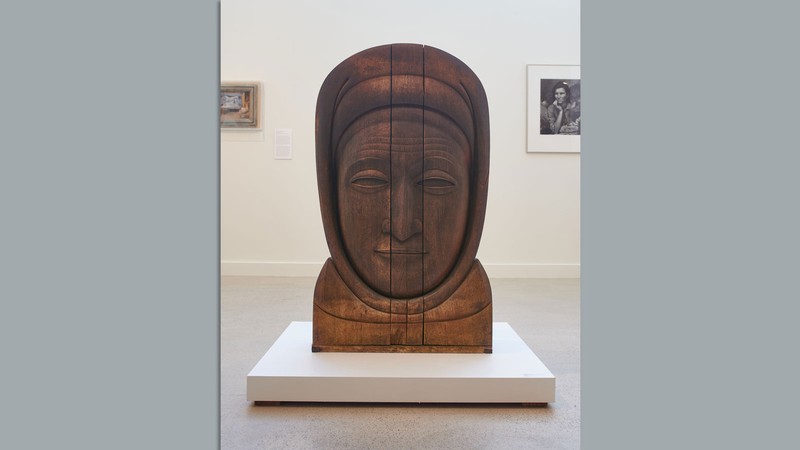
Beniamino Benvenuto Bufano, Madonna, c. 1932, wood, 46 x 27 x 10 ½ in., Collection of the Nora Eccles Museum of Art, Gift of Barry Sloane, 2000.71

The Nora Eccles Harrison Museum of Art at Utah State University is presenting the first major exhibition to examine the pivotal history of the San Francisco Art Association and Bay Area art scene of the mid-20th century.
San Francisco the Golden Age 1930-1960: Making a Scene, on view through July 12, 2025, and its accompanying publication profile agroup of art enthusiasts and artists who exemplified the period’s penchant for individualism and experimentation. The exhibition includes 69 works by artists including Ruth Asawa, Dorr Bothwell, Margaret Bruton, Beniamino Benvenuto Bufano, Harry Crotty, Jay DeFeo, Richard Diebenkorn, Claire Falkenstein, Sonia Gechtoff, Robert Boardman Howard, Sargent Johnson, Adaline Kent, Madge Knight, Knud Merrild, Henrietta Shore, Ralph Stackpole, and Clay Spohn among others. A virtual tour off the exhibition is available.
San Francisco was the center of bohemian culture in California and the western United States in the late 1930s and 1940s. This was a golden era for art making, and Bay Area art blossomed under the influence of the San Francisco Art Association, a group who nurtured the growth of the San Francisco Museum of Modern Art) and the California School of Fine Arts). They also organized yearly annual exhibitions that stimulated and propelled the progressive styles of the time. Yet until recently, their influence remained largely untold in American art history.
San Francisco the Golden Age1930-1960: Making a Scene, drawn exclusively from NEHMA’s collection of art focusing on the western United States, is ideally suited to explore this under-recognized period. The exhibition is co-curated by Michael Duncan, art historian, writer and critic, and Bolton Colburn, NEHMA’s curator of collections and exhibitions.
“The 1940s and 1950s saw the emergence of a startling number of distinctive artists in the Bay Area with the advent of San Francisco Abstract Expressionism (Clyfford Still, Richard Diebenkorn, Hassel Smith), Bay Area Figuration (David Park, Elmer Bischoff), the rise of women artists (Claire Falkenstein, Ruth Asawa, Jay DeFeo), the Dynaton movement, and the birth of California assemblage. Today’s art world stresses the lack of inclusion and colonialist tendencies of former eras. But it is important to consider how an art scene from almost a century ago could get so many things right. The NEHMA collection of West Coast American art from this period exemplifies the fertile creative spirit of this remarkable time," said co-curator Michael Duncan.
Exhibition Highlights
Among notable artworks in the exhibition are Beniamino Benvenuto Bufano’s Madonna (c. 1932), a totem-like wood carving of the face of a female deity embodying a sense of peace and safety — a common theme in his sculptures. Having moved to California around 1913, Bufano began receiving commissions throughout the state leading to his reputation and esteem as a public sculptor.
Adaline Kent’s Gambler (1948) is a biomorphic tabletop work combining a witty exploration of the interface between positive and negative space with the earthiness of ancient painted terra-cotta. A significant work in Kent’s oeuvre, it was included in several important exhibitions, including her first solo show at the Betty Parsons Gallery in New York in 1949 and Abstract Painting and Sculpture in America at The Museum of Modern Art in 1951.
Pamela Boden’s, The Magician’s Castle (1950) shows the artist’s use of natural materials to create a sense of motion by gluing together pieces of wood to portray surreal landscapes, birds, and animals. In 1946, after immigrating to the United States from England, she exhibited with Clyfford Still at Peggy Guggenheim’s Art of This Century Gallery in New York.
Richard Diebenkorn’s Untitled (Albuquerque) (1952) reflects the influence of the vast landscape of the western United States on the artist, even as he embraced the current vogue of Abstract Expressionism. In 1949, Diebenkorn began studying for his graduate degree at the University of New Mexico in Albuquerque and moved to Berkeley, California in 1952. Throughout his career, he remained inspired by the landscape. His best-known works, the abstract “Ocean Park” series, began when he moved to Santa Monica in 1966.
Publication
San Francisco the Golden Age 1930-1960: Making a Scene
Hirmer Publisher, Munich, Germany/NEHMA, Utah State University, Logan, UT184 pages | $50 USD | October 2024 | Available for purchase here.
The publication includes 150 images, essays by Michael Duncan, and a foreword by Bolton Colburn and details the extraordinary development of the Bay Area art scene from 1930 to 1960—an environment that nurtured a host of innovative artists and helped put it on the map. The 1940s and 1950s saw the emergence of a startling number of distinctive artists in the Bay Area including Ruth Asawa, Richard Diebenkorn, Claire Falkenstein, Jay DeFeo, and Clyfford Still. Working far from art world powerbases in Europe and New York, these artists developed practices that are only now being fully recognized.
The Nora Eccles Harrison Museum of Art
The Nora Eccles Harrison Museum of Art (NEHMA) is dedicated to collecting and exhibiting modern and contemporary visual art to promote dialogue about ideas fundamental to contemporary society. NEHMA provides meaningful engagement with art from the 20th and 21st centuries to support the educational mission of Utah State University, in Logan, Utah. NEHMA offers complementary public programs such as lectures, panels, tours, concerts, and symposia to serve the University and regional community. Admission is free and open to the public. http://artmuseum.usu.edu/
CONTACT
Katie Lee-Koven
Executive Director and Chief Curator
Nora Eccles Harrison Museum of Art
435.797.0164
Katie.lee.koven@usu.edu
SHARE
Comments and questions regarding this article may be directed to the contact person listed on this page.