Orbital Bond: Award Reunites USU Prof, Alums at Air Force Research Lab
About five years ago, Utah State University graduate student Ryan Hoffmann and his faculty mentor, J.R. Dennison, were hard at work determining what sorts of materials could be used to construct NASA’s planned Solar Probe. Since renamed Solar Probe Plus, the spacecraft, slated to launch no later than 2018, will explore the Sun's atmosphere approximately four million miles from the star's surface.
(Four million miles is about 15 times the distance from Earth to the moon. While it may seem an interminable distance to an earthling, the probe’s unprecedented mission will allow it to travel closer to the Sun’s sizzling surface than any manmade object has ventured before.)
Hoffmann, a USU physics alum who earned a bachelor’s degree in 2004 and a master’s degree in 2010, has since moved on to the Air Force Research Laboratory at New Mexico’s Kirtland Air Force Base. He serves as managing director of the recently established Spacecraft Charging and Instrument Calibration Laboratory in the Battlespace Environment Division of the Space Vehicles Directorate.
“Our work involves research into ways to protect space satellites and instruments from the punishing effects of space weather,” says Hoffmann, who placed first in the annual Frank J. Redd Student Scholarship Competition at the 2008 AIAA/USU Small Satellite Conference.
The research physicist will soon be joined by a familiar face: Dennison received a Research Associateship Award from the National Research Council of the National Academies for a 12-month assignment at the very directorate where Hoffmann works. Dennison reports for duty in January 2012.
“This is a welcome reunion,” says Dennison, professor in USU’s Department of Physics. “We’re at the right place at the right time to make some significant advances.”
Dennison has studied single-layer materials for space use for nearly 20 years. Among other projects, students in his Materials Physics Group are evaluating more than 150 samples that flew on the outside of the International Space Station from March 2008 through September 2009 as part of a NASA-funded experiment. Information from the experiment will assist NASA as it develops future missions, including the James Webb Telescope — successor to the Hubble, the Jupiter Moons Mission, Earth-based satellites, along with vehicles and instruments planned for future Mars missions.
“Space is a harsh environment,” Dennison says. “Things change dramatically out there. Very small changes can have huge effects that can damage equipment, endanger astronauts and lead to catastrophic failures.”
At Kirtland, he and colleagues will explore multi-layer materials for space use. In addition to Hoffmann, Dennison will collaborate with another of his former students: Tim Doyle MS’91, PhD’03, a former USU faculty member now with Utah Valley University. Funding permitting, they hope to be joined by USU alum Lee Pearson PhD’83, who has led ATK’s ultrasonics non-destructive test group.
“We have an astounding confluence of ideas and skills,” Dennison says.
Among their research activities, the team will use ultrasonics to examine electrostatic discharge inside materials. In tests, the researchers will create “Lichtenberg figures” — also known as “Lichtenberg trees or lightning trees” — in test materials.
“The paths etched in the plastic by charges in these materials are like shock waves from lightning captured in the air,” Dennison says. “By examining these, we can probe the effects of charges deposited in these materials. This information will help us determine the kinds of materials that can be used for spacecraft and satellites envisioned for ambitious, long-duration space missions.”
Related links:
- “They’re Ba-ack: Aggie Physicists’ Space Samples Return to USU,” Utah State Today
- “USU Physics Student Excels in International Satellite Competition,” Utah State Today
- “Lessons from Icarus,” Utah State Today
- USU Department of Physics
- USU College of Science
Contact: J.R. Dennison, 435-797-2936, jr.dennison@usu.edu
Writer: Mary-Ann Muffoletto, 435-797-3517, maryann.muffoletto@usu.edu

In 2007, J.R. Dennison, top, with Ryan Hoffmann '04, MS’10 and Jennifer Albretsen Roth '09. Via a National Academies award, Dennison resumes research with Hoffmann. Roth, a Goldwater Scholar at USU, earned a master’s degree from Oregon State in 2010.
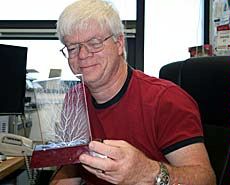
Dennison examines a decorative Lichtenberg Tree he keeps on his desk. He and his research team will use ultrasonics to test a similar idea to examine the effects of electrostatic discharge in space on varied materials.
SHARE
Comments and questions regarding this article may be directed to the contact person listed on this page.