The Yin and Yang of Cell Signaling
Consider your body. Day by day, second by second trillions of minute cells undergo a complex array of continuous chemical processes at a dizzying rate. Through the endless ebb and flow of biochemical reactions, life is kept in precarious balance. A kink in the chain and illness, even death, ensues.
Utah State University organic chemist Alvan Hengge delves into the chemistry driving biological systems and seeks to understand how various enzymes accomplish what he calls “remarkable chemistry.”
Simply put, enzymes are proteins that catalyze chemical reactions, or trigger activity, in living cells.
The enzymatic mechanisms of phosphate and sulfate transfer are a specific research focus for Hengge, professor in the College of Science’s Department of Chemistry and Biochemistry. “These processes have great importance in biological systems,” he says.
His work with W. Wallace Cleland, co-director of the Institute for Enzyme Research at the University of Wisconsin-Madison, where Hengge is currently on sabbatical, appeared in a recent issue of Chemical Reviews. He presents his research this month at the
Australian Society for Biochemistry and Molecular Biology annual conference in Brisbane, Australia.
“What we’re looking at is how phosphatases and kinases work,” says Hengge, who adds that human attempts to create catalysts as effective as these natural enzymes have consistently fallen short.
Phosphatases and kinases are two broad classes of enzymes that essentially function as “on” and “off” switches to control various biological processes. Opposing yet complementary controllers, Hengge says the two are often referred to as the “yin” and “yang” of cellular signaling.
Kinases synthesize phosphate esters, and phosphatases destroy them. “These dual, opposing activities serve to keep proper levels of activity of particular proteins and receptors in balance within each cell,” he says.
Easier said than done.
What confounds chemists, says Hengge, is how these enzymes accomplish their regulatory functions with such speed and ease in nature. Efforts to replicate these processes in the lab are extremely difficult.
Phosphate esters, which are substrates of phosphatases, are extremely stable, says Hengge. Very harsh chemical or kinetic stimuli are required to elicit a reaction from them in a lab setting. How, scientists wonder, do these enzymes ever reach a transition state in the relatively mild environment of a healthy organism?
“The stability of phosphate esters is a protective mechanism that enables the cell to maintain very tight control of this regulatory process and protect the organism’s delicate balance,” says Hengge. “This makes sense from an evolutionary standpoint.”
“We’re trying to understand the transition states that enzymes stabilize during their reactions,” he says, of the tiny chemical-reaction machines that constantly deconstruct and rebuild their substrates like tinker toys.
Hengge describes the transition state as the “fleeting geometry that any reacting compound must go through when it changes from a reactant form to a product.”
“In terms of energy, think of a ball flying through the air from one point to another,” he says. “The highest point on the arc traveled by the ball is the transition state.”
Hengge says biochemists have speculated that the enzymes use a mechanism different from what is observed during uncatalyzed reactions of phosphate esters, but this does not seem to be the case.
Scientists clearly have their work cut out for them, as further study into the structure of enzymes is needed to understand their powerful abilities. For the next few months, the chemistry community can mull over Hengge’s findings without him, as he switches gears and shifts his research focus to molecular biology and thermodynamics in the biomolecular chemistry department at UW-Madison’s medical school.
“That’s what sabbaticals are for—to learn new things,” says Hengge who, in spite of the proximity, is not currently pursuing further study with his colleague and former postdoc mentor Cleland.
Hengge calls UW-Madison, where he worked as a National Institutes of Health-funded postdoc researcher from 1987-90 and was an assistant scientist for six years beyond that, his “second home.”
“Mo (Cleland) and I are not conducting research together, but we’re getting the opportunity to catch up and socialize,” he says.
Hengge returns to Logan in January 2007.
Related Links:
Cleland, W. Wallace and Alvan C. Hengge, “Enzymatic Mechanisms of Phosphate and Sulfate Transfer,” Chemical Reviews, 2006, Vol. 106, No. 8, pp. 3252-3278.
Contact: Alvan Hengge, 435-760-1472, hengge@cc.usu.edu
Writer: Mary-Ann Muffoletto, 435-797-1429, http://maryann.muffoletto@usu.edu
USU organic chemist Alvan Hengge's research on enzymatic mechanisms of phosphate and sulfate transfer appeared in a recent issue of Chemical Reviews.
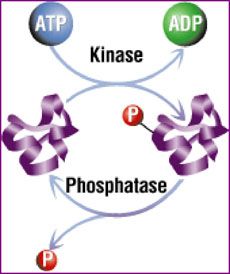
Opposing yet complementary controllers, Hengge says phosphatases and kinases are often referred to as the 'yin' and ‘yang’ of cellular signaling.
SHARE
Comments and questions regarding this article may be directed to the contact person listed on this page.