
Writing Learning Objectives
What are Learning Objectives
Establishing learning objectives should be the starting point for your course. Your department may already have these created so be sure to check with your department chair. If these have not been developed, this section will help you understand the process of developing and writing learning objectives.
Learning objectives are statements that describe what a student will be able to do by the end of a course or unit of study. These objectives should align with your instruction, activities, and assessments. As you design your course, start with the course objectives, then build your module objectives. After all of the objectives have been created, you are ready to develop instructional materials, activities, and assessments. Proper alignment will follow this model.
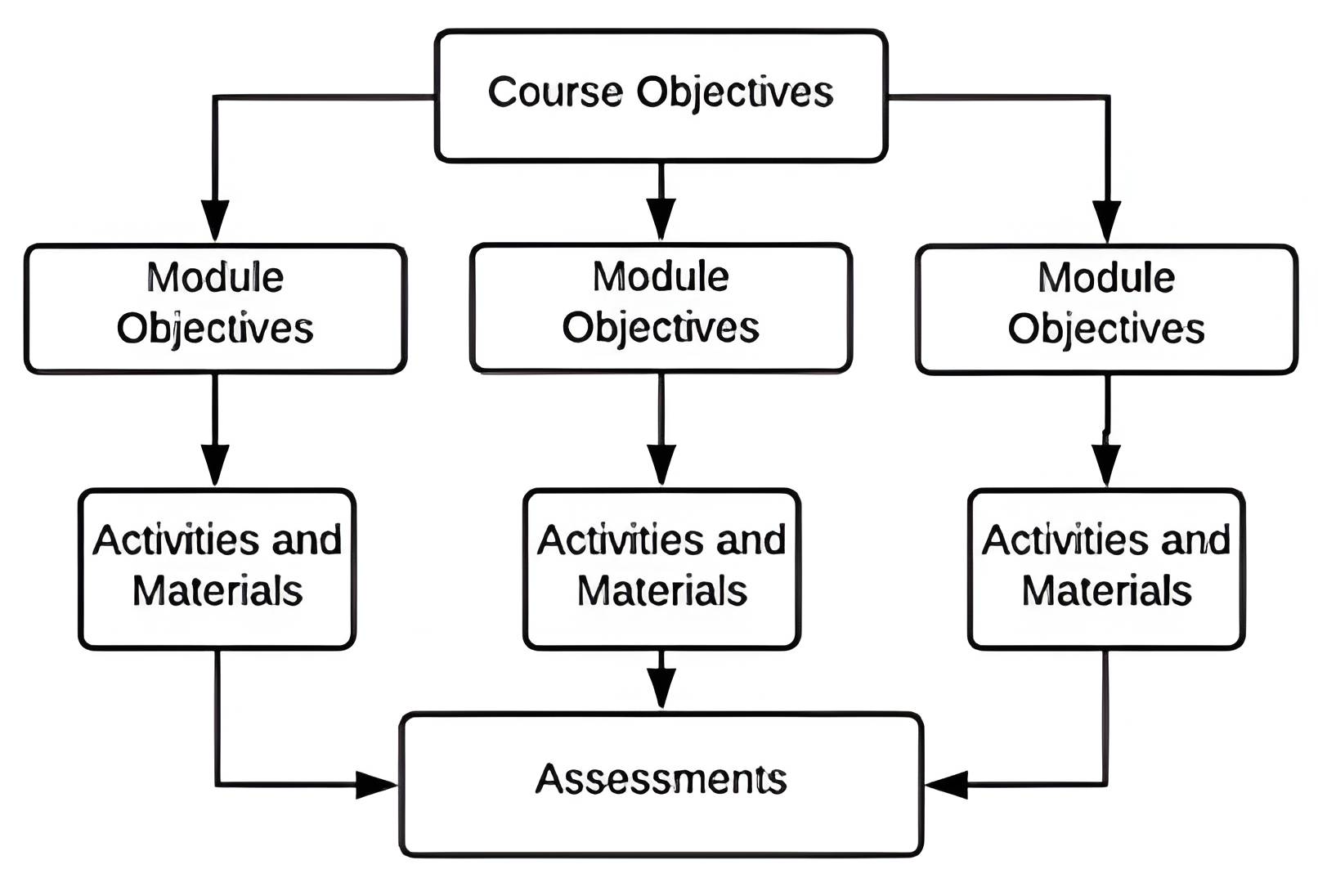
Course Objectives
Course objectives will be much broader than module objectives. You should have three to five course-level IDEA outcomes. The IDEA outcomes are a good starting point for developing your more specific course objectives. Each course objective will need to be:
- Specific - Course objectives should only focus on one specific task/action required of students.
- Measurable - Student attainment of objectives should be something that can be observed and assessed in some way.
- Written from the learner’s perspective - Objectives should not be stated as topics you intend to teach, but rather what students will do with the information. The language used in the objectives should avoid discipline specific jargon.
- Matched to the course level - Course objectives in an introductory level undergraduate course should look very different from objectives for a graduate level course. Introductory courses generally focus on lower order skills such as remembering, understanding, and application while graduate courses tend to focus on analysis, evaluation, and creation.
- Aligned - Course objectives should align back to and fit within the goals and outcomes of the larger program.
Example: By the end of the course, students will be able to use critical thinking to analyze strengths and weaknesses of psychological research.
Module Objectives
A module objective is an observable skill students can combine with other skills in order to demonstrate fulfillment of a course objective. The main difference between module objectives and course objectives is scope. Course objectives are much broader in scope than module level objectives. Module objectives break down skills and knowledge into very specific, discrete skills, while course objectives point more to culminating student ability and higher level thinking skills. In a module, you may have 10 or more objectives explaining all of the tasks or skills involved in learning a concept. But in a course, you should have only about 3-5 course objectives.
In looking at the course objective noted above, an instructor might create the following module objectives.
Examples:
- Describe the steps of the scientific method.
- Define the components of a research article.
- Differentiate among research methods.
- Determine biases in a research sample.
- Evaluate ethical criteria in research studies.
The diagram below explains the relationship between college goals and outcomes, program outcomes, course objectives, and module objectives: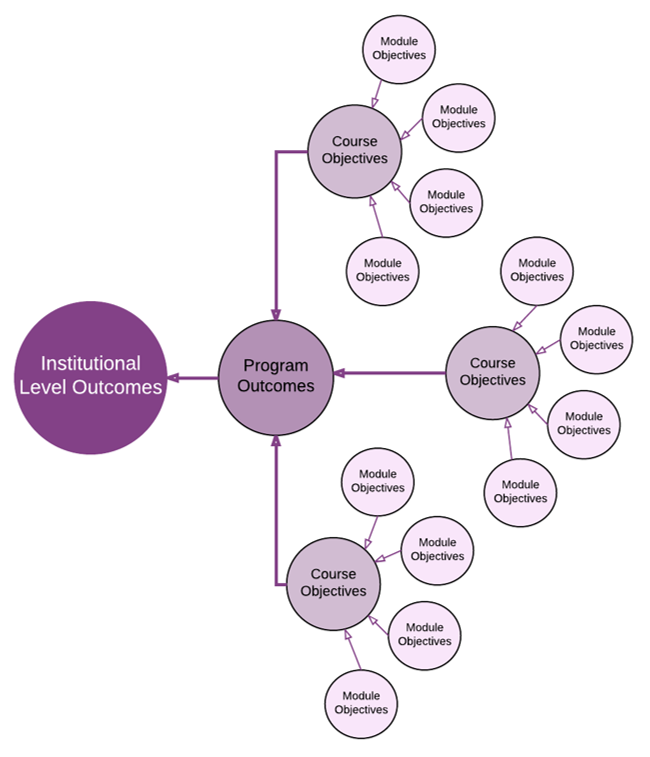
IDEA Course Evaluation and Objectives
The IDEA Educational System uses 13 specific learning objectives to define, guide and measure course goals, teaching methods, and student progress. Instructors select a few essential or important goals that match their teaching plans.
For reference, the 13 general IDEA objectives are:
- Gaining a basic understanding of the subject (e.g., factual knowledge, methods, principles, generalizations, theories)
- Developing knowledge and understanding of diverse perspectives, global awareness, or other cultures
- Learning to Apply Course Material (to improve thinking, problem solving, and decisions)
- Developing specific skills, competencies, and points of view needed by professionals in the field most closely related to this course
- Acquiring skills in working with others as a member of a team
- Developing creative capacities (inventing, designing, writing, performing in art, music, drama, etc.)
- Gaining a broader understanding and appreciation of intellectual/cultural activity
- Developing skill in expressing myself orally or in writing
- Learning how to find, evaluate, and use resources to explore a topic in depth
- Developing ethical reasoning and/or ethical decision making
- Learning to analyze and critically evaluate ideas, arguments, and points of view
- Learning to apply knowledge and skills to benefit others or serve the public good
- Learning appropriate methods for collecting, analyzing, and interpreting numerical information
Selecting Objectives
IDEA recommends that a total of 3-5 objectives is a good rule of thumb. You can select them as either "important," or "essential," with essential objectives double weighed (counting twice) in the calculation of your averages. Both important and essential objectives should be counted towards your overall total (e.g. pick 3-5, not 6-10). The best approach to selecting objectives is to ask three questions:
- Is this a significant part of the course?
- Do I do something specific to help students accomplish this objective?
- Does the student's progress on this objective affect his or her grade?
If you can answer "yes" to all three questions for a particular objective, it should be selected as either "important" or "essential."
Faculty should be "true to their course" when deciding how many objectives to select. In other words, if you are teaching a lab course where only one objective seems appropriate, then just select one. If you are teaching a senior capstone class for the major, and you feel you should select more than five, then feel free to do so. Be true to your course.
The selection of objectives on the Faculty Information Form is a crucial activity for two reasons. First, the IDEA System evaluates teaching by assessing student progress on these unique, instructor-chosen objectives. Second, objectives provide guidance for selecting teaching methods; those that promote progress on one type of objective may differ from those that promote progress on other types. Differential objectives make each course a unique learning experience.
Although objectives can be stated in a variety of ways, they should always focus on expected effects on students, not on the instructor's actions or procedures designed to promote learning. It is desirable for each instructor to develop statements or objectives as precisely and comprehensively as possible. In order to participate effectively in the IDEA program, it will be necessary to interpret these statements within the framework provided by the 13 objectives listed on the Faculty Information Form.
Tips
Help students make the connection between your IDEA objectives and the course objectives by providing a table that shows the relationship. The table below is an example from Heidi Wengreen's Advanced Sports Nutrition class. It is also helpful to periodically remind students of the connection between objectives, especially as you near the end of the semester and students are getting ready to fill out their course evaluations.
IDEA Learning Objectives and Outcomes
| IDEA Learning Objectives | Course Learning Outcomes (at the end of this class students will be able to...) |
|---|---|
| Object 4. Develop specific skills, competencies, and points of view needed needed by nutrition professionals. |
|
| Objective 3. Learning to apply course material. |
|
| Objective 11. Learning to analyze and critically evaluate ideas, arguments, and points of view. |
|
IDEA Survey Completion Confirmation
After the evaluation period has closed, you may see which students have completed evaluations. (Log into the faculty portal, then follow the instructions for viewing student completion.)
Canvas Resources and Outcomes
You may request a Canvas assignment to automatically award points to students for completing a teaching evaluation for your class by filling out the IDEA Canvas assignment request form. (Access requires faculty login. Must be requested EACH semester.)
Canvas outcomes are helpful for defining a certain level of mastery and Canvas will provide a report of where students rank on the specified outcomes. In the video below you will get an overview of this feature. You may want to discuss with your instructional designer whether adding Outcomes would be beneficial for your course.
Additional Resources
For those who are looking for additional help, we have developed a worksheet to walk you through the process of writing learning objectives. (Download File).