Feelings From the Forest: USU Doctoral Candidate Leads Community Nature Engagement Efforts
Ecologist Kate Hunter, who conducts research on bees in Biology's Kapheim Lab, serves as director of education for the Logan Canyon-based nonprofit Stokes Nature Center.
By Mary-Ann Muffoletto |
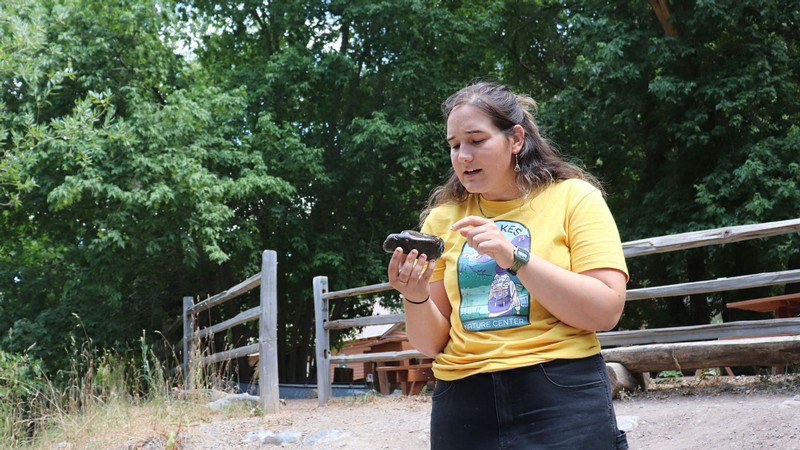
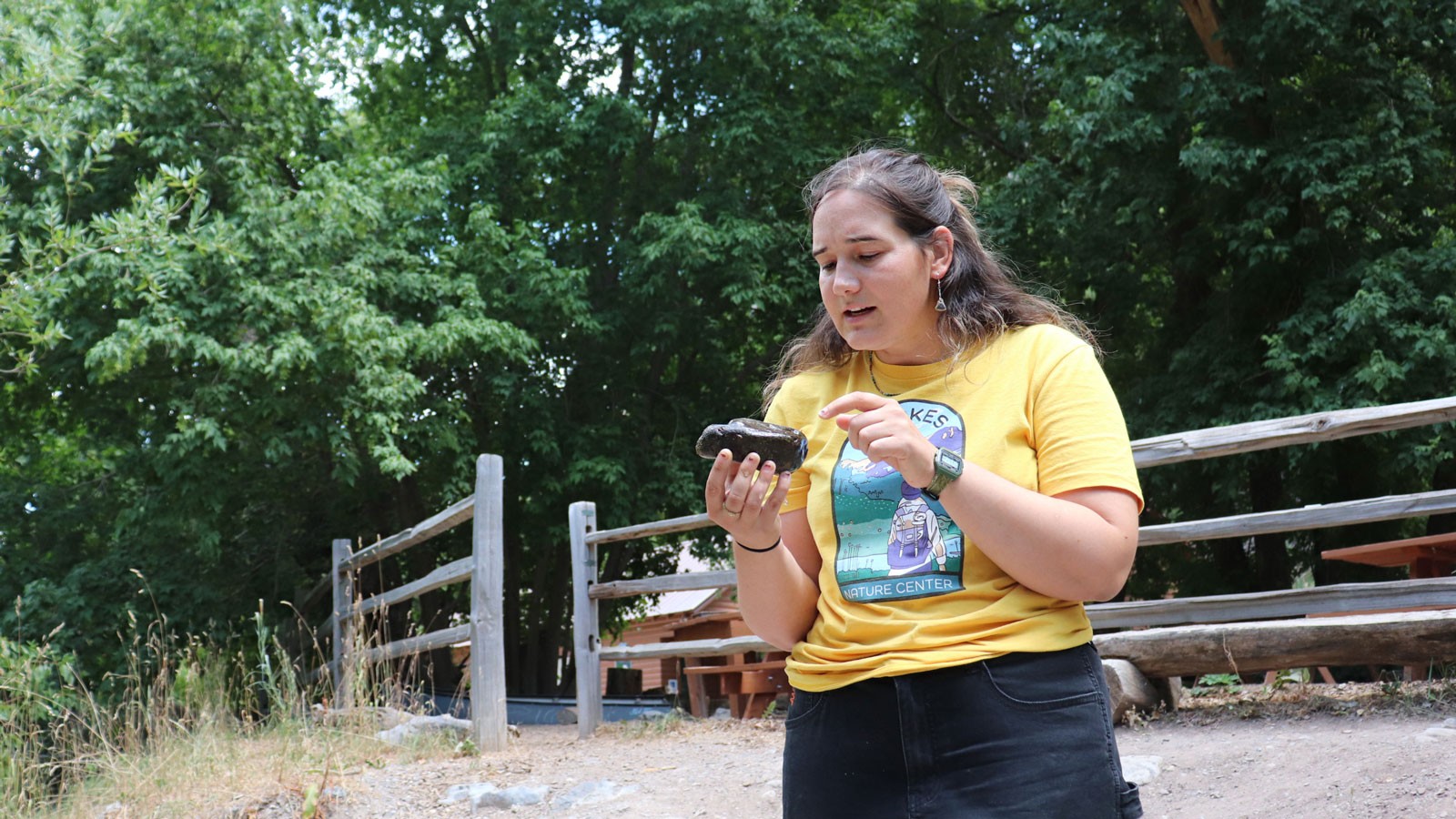
USU doctoral candidate Kate Hunter observes aquatic macroinvertebrates on a rock pulled from the Logan River at Stokes Nature Center in Logan Canyon. The Department of Biology and USU Ecology Center scholar serves as director of education for the nonprofit community center. (Photo credit: USU/M. Muffoletto)
Cache Valley, home of Utah State University’s main campus, is known for its scenic agricultural fields and rivers, along with sweeping, encircling views of the Wellsville Mountains and the Bear River Range. Yet valley growth sometimes makes life seem busier and less than tranquil, says USU ecologist Kate Hunter.
Hunter cites a 2024 survey conducted by the USU-led Utah Wellbeing Project that reveals Logan residents rank overall wellbeing lower than many residents of more urban areas along the Wasatch Front, as well as similarly rural-suburban communities throughout the northern part of the state.
“This comes as a surprise to many, but Logan ranked third from last in ‘community connection’ among the 51 Utah communities in the survey,” she says. “But when you consider the valley’s rapid expansion during recent years, you can understand the growing pains that can leave people feeling disconnected from each other, as well as disconnected from nature.”
Hunter, a doctoral candidate in the Department of Biology and USU Ecology Center who studies social bee health and behavior with the Kapheim Lab, is director of educational programs at Stokes Nature Center, a nonprofit community nature center based in Cache National Forest’s Logan Canyon.
To address community needs, in spring 2025 Hunter and her SNC colleagues initiated the monthly Community in Nature series, which is focused on teaching participants tools for building community. The inaugural series, which recently concluded and will resume in 2026, receives support from USU’s Heravi Peace Institute in the College of Arts and Sciences.
“We secured additional funding from a Utah Humanities program grant to support the series, which brings people together to hear from speakers with varied community-building expertise,” she says. “During our inaugural series, from April to September 2025, we explored such topics as navigating conflict, joy and awe.”
Hunter says people’s sense of connection to nature is intertwined with their sense of connection to each other.
“Gathering in a natural setting, away from the stressors of urban life, our Community in Nature series allows participants to explore their feelings and sense of community connection,” she says. “People are evolved to be steeped in nature. Away from artificial noises, voice and light, our brains can rest. It’s as though the wind and rain wash away the noise of modern life.”
She says series speakers and participants share information, not judgment.
“The emphasis is on listening to each other while connecting with nature,” Hunter says. “So far, our participants report a 90 percent improvement in their sense of connection to others. They’ve offered a lot of very sweet comments about how glad they were about participating in the gatherings.”
The Colorado native says her trajectory follows a somewhat non-traditional path for an academic.
“As a graduate student, I’ve enjoyed teaching and outreach activities, and before applying for the position with Stokes, I’d been exploring career opportunities outside of academia that help people connect with nature,” she says. “I love my research and the skills I’ve gained from it, but I’d been hungering for a way to make more of an impact on the health of my community and the surrounding natural world.”
Prior to her current position, Hunter interned with the Science for the Classroom Division of the Washington, D.C.-based Smithsonian Science Education Center, where she developed classroom curricula designed to meet Next Generation Science Standards set by the National Research Council.
“I find myself constantly drawing on what I’ve learned in my graduate program,” she says. “From project management to completing complex goals, to grant writing and reporting, to all the skills I’ve learned as a teaching assistant, the work is surprisingly similar.”
Hunter also takes pleasure in the opportunity to continue her work with bees.
“At the center, we recently worked with an Eagle Scout who completed observation nests for solitary bees,” she says. “This means I’ll get to share with visitors all the weird and cool things these bees are doing right under our noses.”
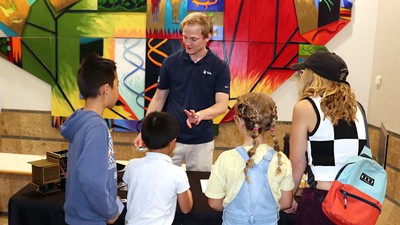
In addition to the Community in Nature series, the center offers varied programs for all ages ranging from popular summer camps for teens and children, along with a nature preschool and free story times for children, and natural history talks on Saturdays. A new program, Learning Outdoor Skills and Technology, in collaboration with Bridgerland Technology College, started this fall.
Hunter says the center looks forward to the opening of its new exploration park and outdoor classroom in Nibley, located at 99 W. 2600 South, across from Ridgeline High School. The new 11-acre facility, funded by a $1.9 million U.S. Economic Development Administration grant, is expected to open in 2026.
“We’re always asking, ‘How do we bring everyone in?’” she says. “’How do we get people of all ages to put down their screens and engage with each other and nature?’”
Hunter says her interest in community-building among humans mirrors her graduate research on bees.
“I study social bees, which display complex behaviors and division of labor,” says the recipient of the Department of Biology’s Matt Del Grosso Endowed Research Award. “It’s interesting to observe their interactions and collaborations.”
For more information about Stokes Nature Center’s programs, visit the center’s website.
WRITER
Mary-Ann Muffoletto
Communications Specialist
College of Arts & Sciences
435-797-3517
maryann.muffoletto@usu.edu
CONTACT
Kate Hunter
Doctoral Candidate
Department of Biology and USU Ecology Center
kate.hunter@usu.edu
SHARE
Comments and questions regarding this article may be directed to the contact person listed on this page.