Getting Fresh: NourishEd Connects Classrooms to Hungry Utahns, Local Growers
By Lael Gilbert |
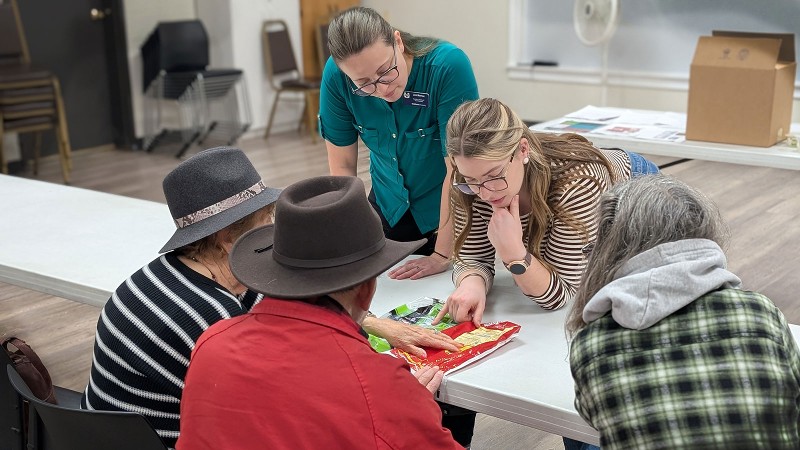
USU students Joni Marrow and Billie Gray examine food labels with participants of the NourishEd program at the Cache County Senior Center. (Photo credit: USU)
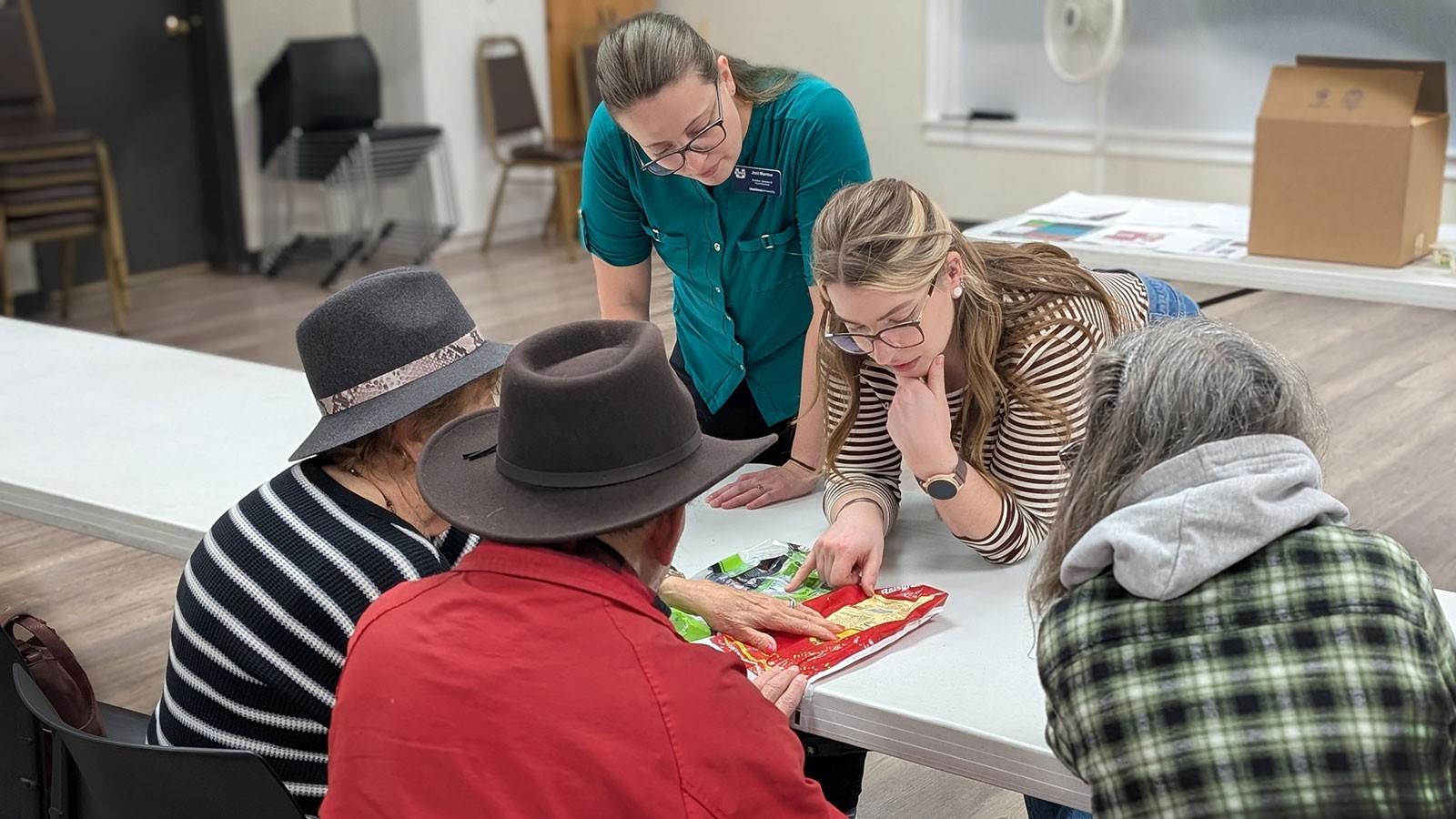
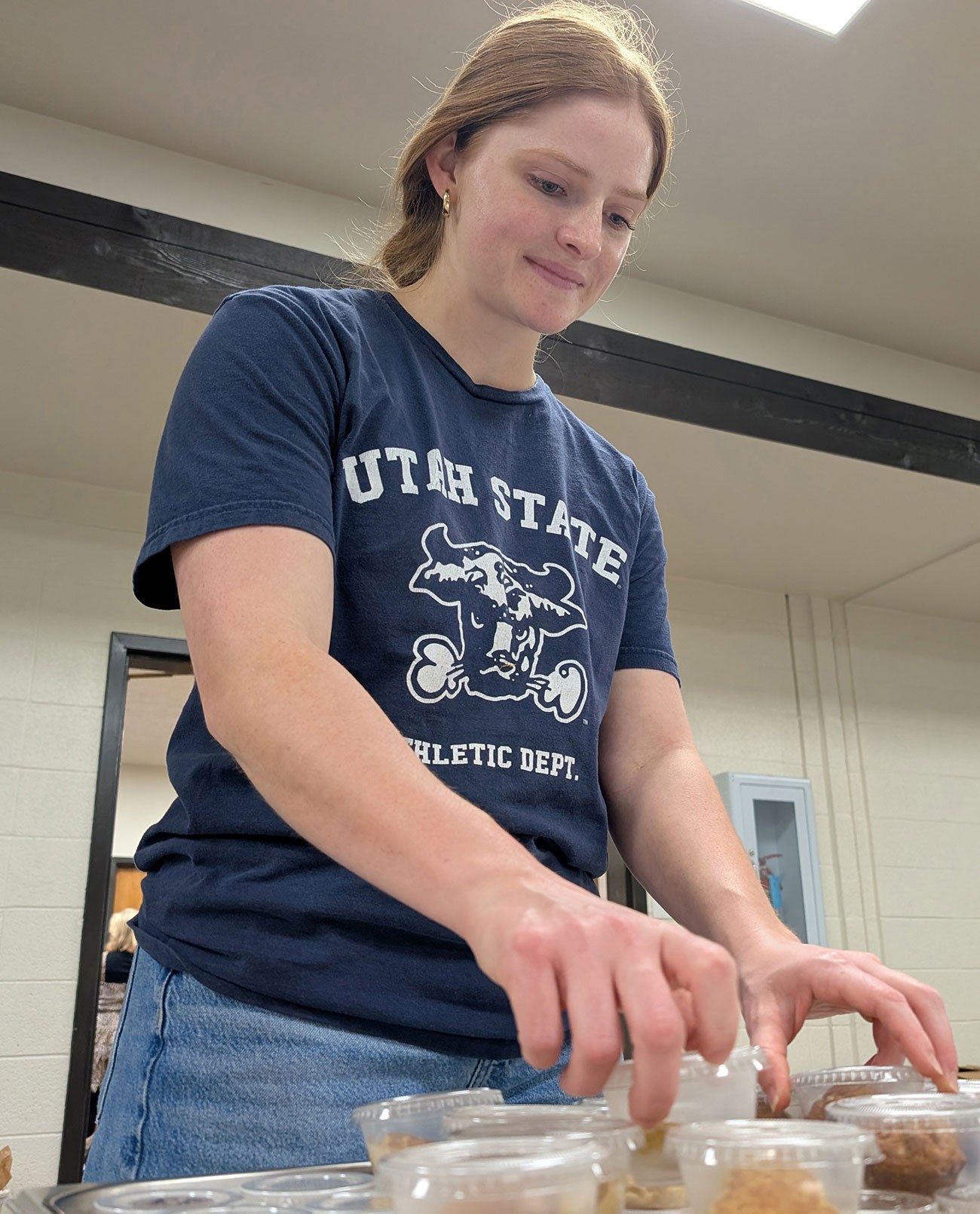
Dietetics intern Joni Marrow turned to face the crowd. The dozen or so older adults in the room were sitting behind long tables, tribunal style, with bite-sized samples of sweet baked squash within easy reach. The group had just finished a back-and-forth discussion about how much sugar is added to processed foods, and there were a lot of questions. Someone raised a hand.
“So … what’s the difference, then, between sugar and honey?”
“Honey is sweeter, more calorie dense,” Marrow said without hesitation. She held out a small cup with some granulated sugar in the bottom. “The American Heart Association suggests that women limit sugar intake to 6 teaspoons or less per day. That looks like this …”
She shook the cup. There wasn’t much there.
It’s the final week of the NourishEd program at the Cache County Senior Center, and this group is engaged, to say the least. Presenters from the Dietetics Internship program seem cool as cucumbers, taking the friendly onslaught with alacrity.
After all, this experience is designed to give students from the Department of Nutrition, Dietetics and Food Science (NDFS) face-to-face experience with just such crowds. No theoretical scenarios or textbooks. Just real people, with real food preferences and budgets, asking frank questions about what might be healthier, what nutrition they can afford, and which healthy foods still taste good.
Marrow passed around containers of yogurt, three flavors from the same brand, and showed the group how to find sugars on the label. The added sugar content varied significantly based on flavor, scandalizing the audience.
“What about fruit juice?” someone called out. “That’s healthy, right?”
Her partner at the weekly nutrition education event, Billie Gray, handled this question.
“Depends,” she said, approaching the table. “What does the label say?”
She helped the questioner decipher the ingredient list.
You might know it’s surprisingly difficult to get science-based nutrition information without misinformation or a product pitch mixed in. The NourishEd program is designed to offer solid information tailored to local Utah audiences, as well as access to free, healthy products from local farms. This year the program purchased from local producers approximately 8,000 pounds of fresh produce and other products, delivered to sites in eight counties in Utah and shared.
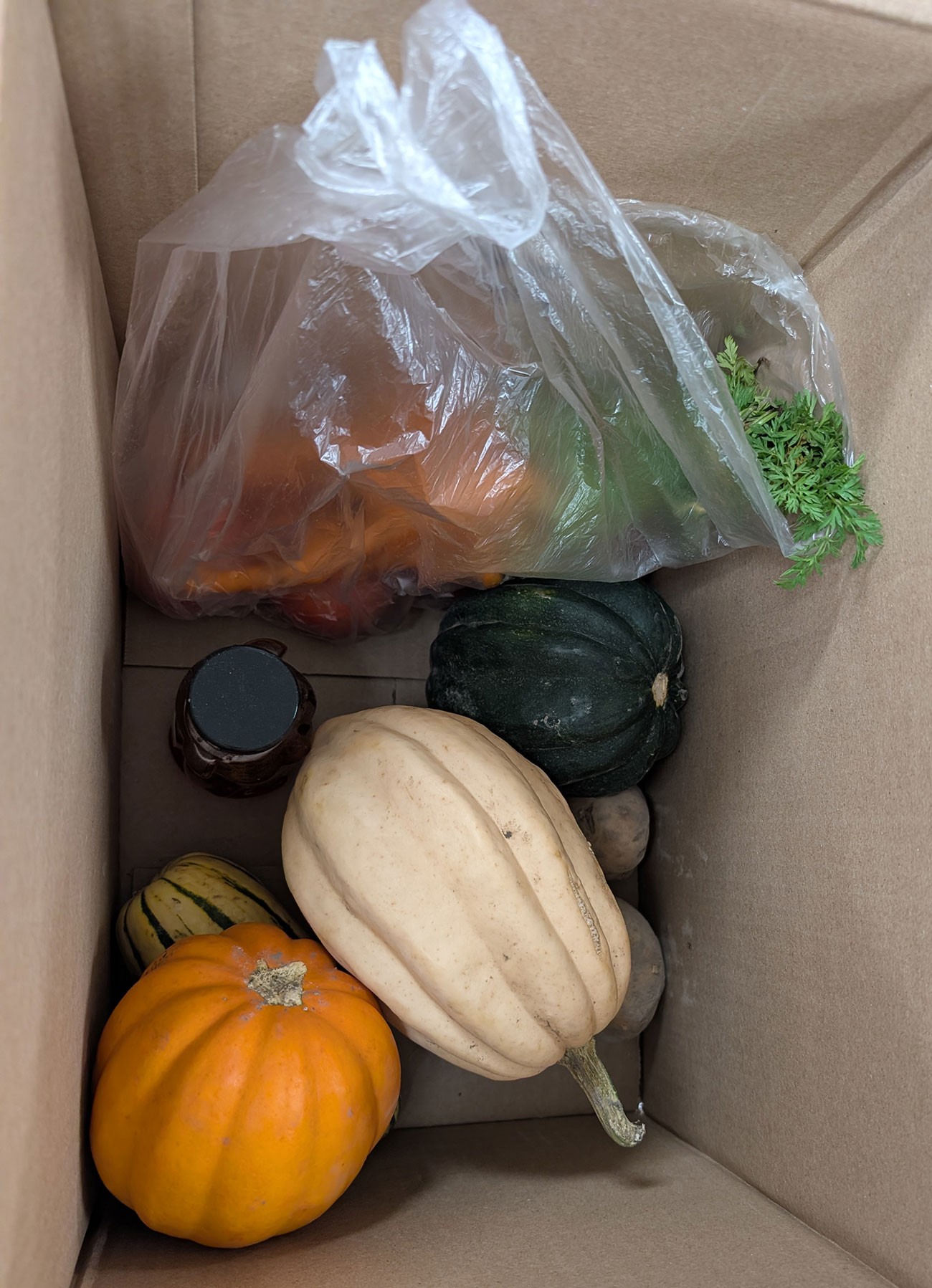
The curious class members went home with three kinds of squash, tiny edible sugar pumpkins, carrots, potatoes, and local honey — and a lot of enthusiasm for trying a recipe for pumpkin pancakes that they’d sampled.
Hunger is a real and growing problem in Utah communities, said NourishEd program coordinator Amberly Lambertsen. Fresh, nutritious foods are often the hardest to access from first-line resources like food pantries. Meanwhile, pantries are dealing with decreased funding and seeing increased demand — though it is difficult to track need because the main federal survey that was used to track food insecurity was recently cancelled, she said.
At NourishEd, presentations pivot based on what’s available from the farm any given week. That makes for a challenge, Gray said, but it’s what home cooks do every day. Sometimes the team hands out bunches of fresh-cut cilantro, beef chunks, or fresh berries, and then tailor the lesson to those ingredients. They let the questions from the class lead the lesson, she said.
“You just roll with it,” Morrow said. “It’s a good lesson for me, to figure out what are their needs versus what we had planned on teaching.”
The NourishEd program has been in existence since 2024, spearheaded this year by the Hunger Solutions Institute with assistant professor Palak Gupta and Lambertsen, and implemented in Cache County by Carrie Durward, professor in NDFS and Extension nutrition specialist, who introduced it at the senior center and an elementary school.
The classes at the senior center initially focused on eating healthily on a budget and reducing food waste — but the organizers soon realized that the older adults were more interested in nutrition information, Durward said. They pivoted to teaching about getting enough protein, staying hydrated, and management of chronic diseases by avoiding added sugars and limiting saturated fat.
This event isn’t the toughest crowd they faced — just try coaxing 30 second-graders to eat cabbage. The elementary school curriculum focused on topics like eating variety, the five food groups, and benefits of different kinds of foods.
“I kept reminding them, it’s OK if you don’t like it, but it’s still good to try,” Marrow said.
The team emphasized that smelling, touching and exploring a food makes children more likely to feel comfortable trying it in the future. They handed out bite-size pieces of crisp, green cabbage sourced from farmers in Cache Valley, and let the children compare the taste, appearance and nutrition to lettuce leaves.
Cabbage wasn’t the whole show, of course. The team served popcorn and talked about whole grains, alongside bread donated from Great Harvest Bakery.
“The point isn’t always to have the kids love every bite … but to expand their palates, to train their minds for tastes from a wider variety of foods and ingredients,” Durward said.
“We've gotten a ton of positive feedback from parents — their children who would otherwise refuse to eat vegetables are suddenly excited about sharing what they learned at school, and getting siblings to try and enjoy the produce they bring home to them,” Durward said.
The local produce was purchased from farms with funds from a Local Food Procurement Assistance grant administered by Utah Department of Health and Human Services from the Utah State Legislature — something the team hopes to receive again next year to continue and expand the program around the state after federal funding faltered. Participating local producers included:
.
- Lost Creek Farms, Magna.
- First Frost Farm, Nibley.
- Paradise Valley Farms, Paradise.
- Lau Family Farm, Soda Springs, Idaho.
- Roberts Family Farms, Kaysville.
- Cox Honeyland, Logan.
- Wasatch Mountain Pastures, Weber County.
- Johnson Family Farms, Cache County.
- Willoughby Produce, Millard County.
- Heritage Farms, Uintah County.
- Openshaw Acres, Santaquin.
- New Roots with IRC/Draper Farms, West Valley.
- Deseret Castle Bees, Carbon County.
The venues for NourishEd in Cache County were chosen based on opportunities to make a difference on the nutrition trajectory of two important groups.
"We wanted to work with children and older folks because both groups have elevated needs and are more likely to experience hunger. These are two key times to practice healthy eating,” Durward said. “What children eat regularly is highly predictive of what they will eat as adults.”
One in five children in Utah experience food insecurity in their home, Lambertsen said, and households with children are much more likely to experience hunger or food insecurity. Older adults are also at elevated risk of food insecurity and malnutrition, which is tied to much worse health outcomes, she said.
“We are getting these nutritious foods directly into the homes of these very families,” she said.
“We work with USU students out in the community, collaborating with USU Extension to help to address real problems while learning through experience and application,” Durward said.
WRITER
Lael Gilbert
Public Relations Specialist
S.J. and Jessie E. Quinney College of Agriculture & Natural Resources
435-797-8455
lael.gilbert@usu.edu
CONTACT
Amberly Lambertsen
NourishSmart Program Coordinator
Hunger Solutions Institute
amberly.lambertsen@usu.edu
TOPICS
Health 398stories Agriculture 283stories Food 226stories Wellness 222stories Nutrition 91storiesSHARE
Comments and questions regarding this article may be directed to the contact person listed on this page.