
Requesting FMLA leave
USU offers up to 12 weeks of unpaid, job-protected leave under the Family and Medical Leave Act (FMLA) for eligible employees.
When to Notify
Give at least 30 days’ notice, if you know in advance of your need for a leave.
If you learn of your need for leave less than 30 days ahead of time, request it as soon as you are able.
You do not need to tell your manager any specifics about your health circumstances or those of your family member. However, you do need to provide enough information so that your manager can understand that your absence may be covered by the FMLA.
Steps for Submitting & Managing Your FMLA Leave
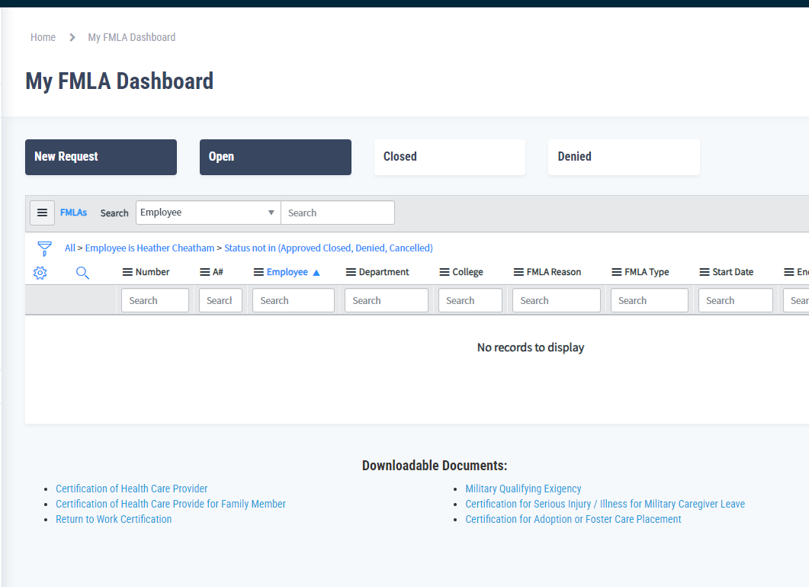
Apply for FMLA Leave and Check your Request Status
Receive Eligibility Notice
Complete the FMLA Health Care Provider form and return it to HR
Receive Approval/Denial Notice
Enter Leave in System
Communicate with HR and Your Supervisor
Complete Return to Work Form
Communicate Your Return to Work Date
What form do I need?
Health-related or Parental Leave: If your absence is for your own, or a family member’s health condition, or for the arrival of a new child, you will need to submit a health-care provider certification form, supporting your need for a leave of absence.
Complete the employee information sections of the appropriate form(s) for your situation. Include your contact information. We need that information so that we can communicate with you and your supervisor regarding your leave needs as explained by your healthcare provider. Your health-care provider should complete the medical information section.
There are links to all of the FMLA forms found on myfmla.usu.edu. You will also be directed to these forms when you request a leave of absence.
Submit the completed form, going to myfmla.usu.edu. Do not give forms to your supervisor. Please upload your forms to myfmla.usu.edu or fax HR @ (435) 797-1816 or hand deliver your forms to the Human Resources office.
The form must be returned to HR within 15 days of receipt. Your healthcare provider may fax your completed paperwork to HR, but we recommend that you get a copy yourself so that you can send it to HR directly, if necessary. Provider offices are well intentioned, but HR forms may not be their highest priority!
FMLA Health-care provider certification forms
- Certification of Health Care Provider for Your Own Serious Health Condition
- Certification of Health Care Provider for Family Members
- Return to Work Certification
- Military Qualifying Exigency
- Certification for Serious Injury/Illness for Military Caregiver Leave
- Certification for Adoption or Foster Care Placement
What if I don’t know how much time I will need?
Medical conditions can change and sometimes you don’t know how much FMLA leave you will need to take. You and your (or your family member’s) healthcare provider need to provide the best estimate of the length of time or frequency of absences you will need based on what is known at the time. If your certification contains responses such as “unknown”, “TBD” or timeframes are left blank, we may be unable to approve your FMLA request. If you require more or less leave than you originally thought, you can always provide an updated certification.
What if I need military duty leave?
If your time off or leave of absence is related to a family member being called to military duty, complete the appropriate form by going to myfmla.usu.edu and provide supporting documentation within 15 days of receiving the form. Contact your HR leave specialist with any questions you may have.
- FMLA Qualifying Exigency Leave – When a family member is deployed to a foreign country with the Armed Forces, your life can change rapidly, often requiring immediate attention to new circumstances.
- If your spouse, parent, son or daughter is a military member who is deployed or has been notified of an impending deployment to a foreign country, you may be entitled to qualifying exigency leave. Qualifying exigency leave allows you to take up to a total of 12 workweeks of FMLA leave for qualifying exigencies, such as arranging new childcare for the military member’s children or attending official military ceremonies as your family member prepares for deployment.
- Military Caregiver Leave – When you need to care for an injured or seriously ill servicemember or veteran, the FMLA can help alleviate the stress of job concerns during this challenging time.
- If you are the spouse, parent, son, daughter, or next-of-kin of a covered servicemember and work for a covered employer, you may be entitled to military caregiver leave. This leave allows up to 26 workweeks of unpaid leave during a single 12-month period to care for your military relative if they have a qualifying serious injury or illness.
What happens after I submit my form?
Once you submit your form(s), HR will review the information you provided, and if it is sufficient, an email will be sent to you and to your supervisor advising of the dates and type of leave and the status of the FMLA leave request.
If the information provided isn’t sufficient, HR will be in touch with you for follow-up with your health-care provider.
Confidentiality
We protect the confidentiality of your health information. You should not disclose your own or your family member’s medical diagnosis to your manager or department. Any required certification should be submitted directly to Human Resources, where it will be kept confidential and separate from your personnel file.
Periodic updates
During your absence, we may ask that you update us periodically about your ability to return to work. If your need for a leave of absence changes significantly or is longer than anticipated, we may ask for an updated health-care provider certification—or you may need to submit a short-term disability claim.
Communicate
If your situation has been approved for intermittent FMLA, any time you need to be absent for your FMLA reason, you must indicate the time off is for your FMLA-certified situation. Let your manager know if you are missing a day of work. Your supervisor should be informed if the leave is related to your FMLA serious health condition, or if it is related to some other leave request. If you have more than one approved FMLA leave, you may need to identify which one you are using when communicating with your manager.
It is recommended that employees make sure they are communicating scheduled appointments, flare-ups, or treatment with their supervisors in advance, so the supervisors are able to appropriately staff their departments. When unexpected health issues related to the FMLA leave arise it is advised to notify your supervisor as soon as possible about your absence. Employees and Supervisors should work together to schedule absences that are less disruptive to the operations. If an employee is on intermittent FMLA leave, it is important the employee make reasonable efforts to follow the doctor’s recommendations and schedule absences that are less disruptive to the departments operations. This ensures the employee's supervisor is informed of the employee's needs and can make necessary arrangements.